THE EVOLUTION OF A GRAPE VARIETY
Ruby Red, Steeped in History
There are grape varieties everyone has heard of without really knowing them. Vernatsch is one of them. Glowing ruby red in the glass, with a pronounced fruit and almond aroma, it was for centuries South Tyrol’s wine par excellence. No other red wine has shaped the landscape, the cellars and the palate of South Tyroleans quite like it. And yet today, measured against its former dominance, it leads an almost niche existence. To understand how that happened, one has to look back nearly fifty years.
A Century at the Top
Vernatsch, known in Italian as Schiava, has long been at home in South Tyrol. The earliest mentions date back to the 14th century, when Charles IV in Prague permitted the import of only a few other, expensive wines alongside the “Vernatschia”. The name itself remains something of a puzzle to this day: linguists trace it back to the Italian “Vernaccia”, which in turn derives from the Latin “verna” – a slave born in his master’s house. In a South Tyrolean context, the name first appears in 1490, in a wine account of the Bavarian monastery of Tegernsee, which at the time owned extensive vineyards in Bolzano and the Überetsch.
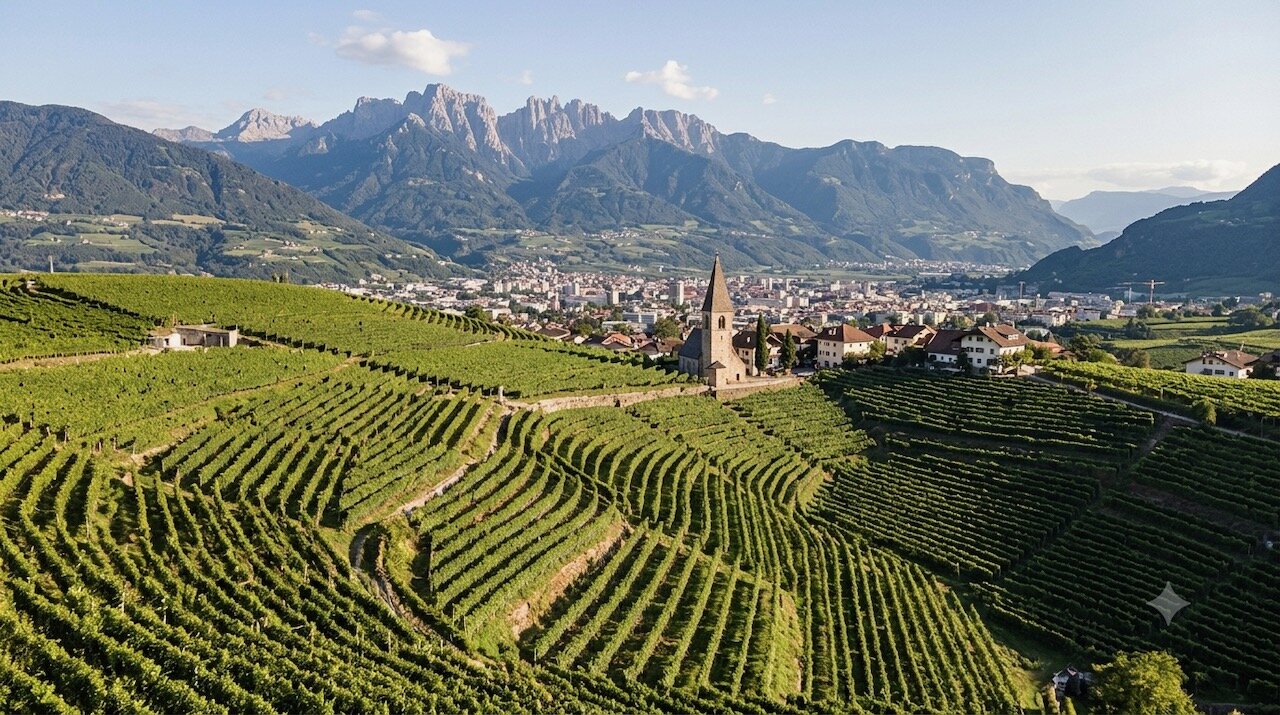
Vernatsch only became a true mass-market variety much later. After the phylloxera catastrophe from 1901 onward and the First World War, vineyards had to be replanted on a large scale, and strong demand from German-speaking countries after the Second World War did the rest. By the end of the 20th century, Vernatsch accounted for up to 70 percent of South Tyrol’s entire wine production – a figure no other variety in the region can come close to today. The first serious blow to this dominance came with the wine crisis of the 1980s, when traditional export markets in Switzerland, Austria and Germany collapsed, and more than a few loyal Vernatsch drinkers turned to other wine regions.
The Numbers Tell a Clear Story
In 1971 the first DOC regulations came into force, ushering in a quality-focused shift that halved Vernatsch volumes within a few decades. A look at the official vineyard area figures makes the shift tangible. In 1978, South Tyrol still had 3,572 hectares under Vernatsch – 67 percent of the total vineyard area and 71 percent of the wine produced. By 1998, that share had already dropped to 48 percent of the area, with 2,362 hectares remaining. And by 2017, it was down to just 807 hectares – a mere 15 percent of South Tyrol’s vineyard land.
The decline is especially stark around Lake Caldaro (Kalterersee), the largest Vernatsch-growing area: in 1978 it still had 2,545 hectares planted; by 2018, only 373. The St. Magdalena area northeast of Bolzano shrank by more than half over the same period, to 178 hectares, while the Merano hillsides (Meraner Leiten) stood at 97 hectares in 2018. Growers converted mainly to internationally more sought-after varieties. Vernatsch lost ground, both literally and figuratively.
The flip side of this decline: wine writer Herbert Taschler sums it up neatly in his reference work Südtiroler Vernatsch – gestern, heute, morgen (Athesia-Tappeiner, 2018) – despite noticeably improved quality, market perception has lagged behind the reality in the cellars for decades. An image deficit that has occupied the industry ever since.
Three Sisters, One Character
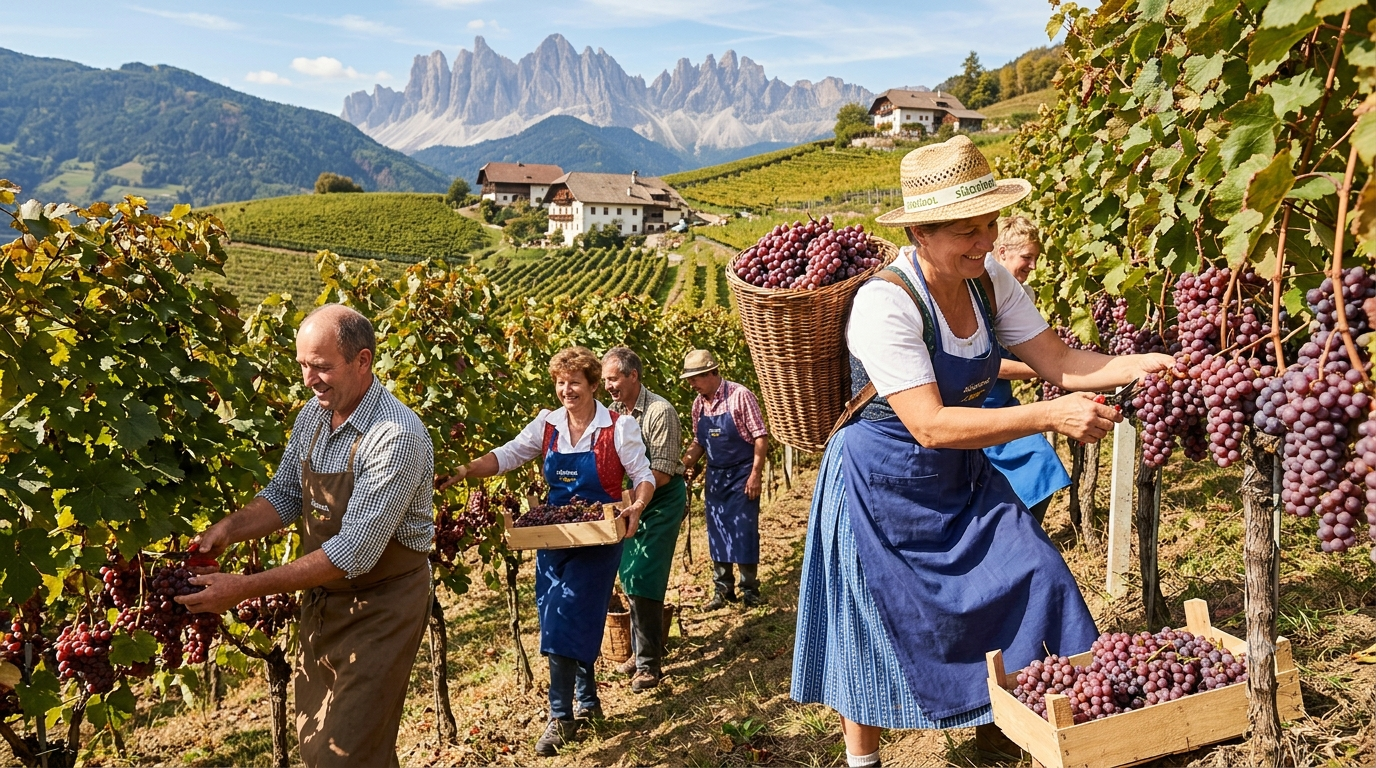
What many don’t know: “Vernatsch” is not a single clone but a small family of closely related varieties that have been distinguished ampelographically since the 19th century.
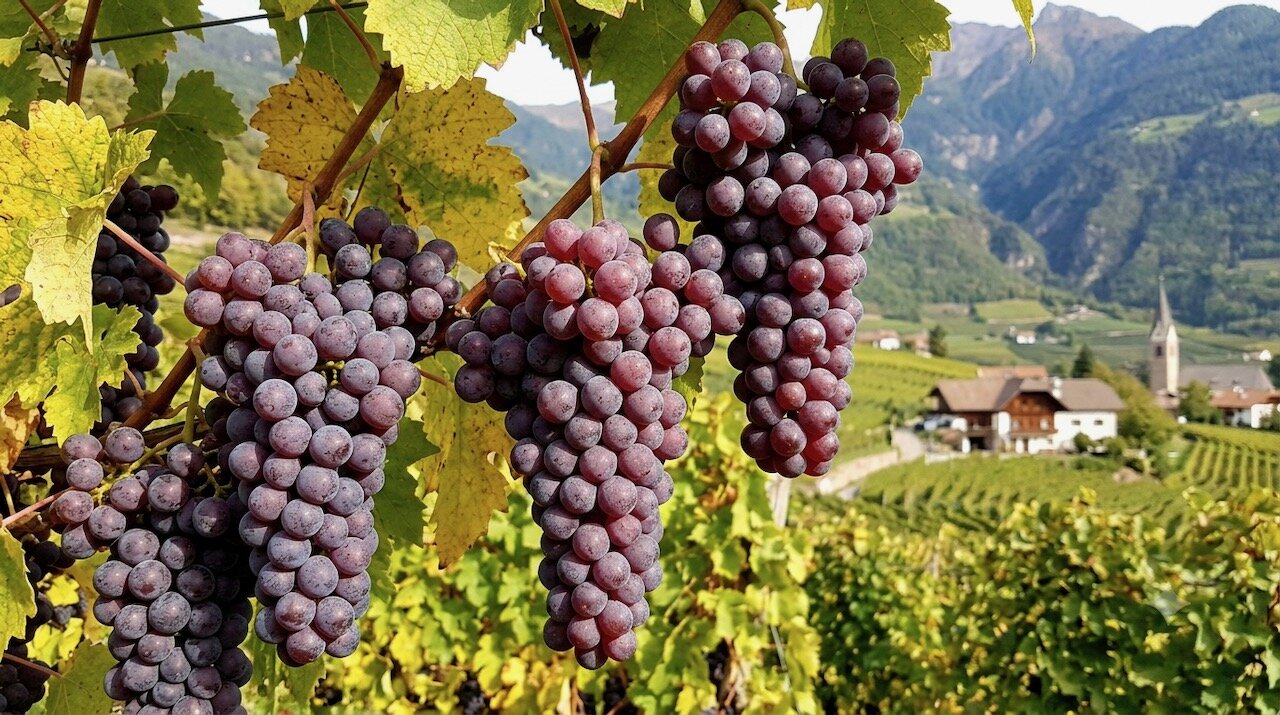
Großvernatsch, known in Italian as Schiava Grossa, is the best-known and today dominant representative. In Württemberg it goes by the name Trollinger, its German twin. Its berries are unusually large, which explains its comparatively pale colour: pigments and tannins sit in the skin, and with large berries the skin-to-pulp ratio is lower. Thanks to intensive clonal research, Großvernatsch today delivers the most reliable quality, which is why wines made predominantly from this variety are often labelled “Edelvernatsch”. Historically, the Burggrafenamt area around Merano was its main growing region.
Mittervernatsch, also called Kleinvernatsch or Schiava Gentile, is considered by ampelographers and oenologists to be, paradoxically, the most valuable of the three varieties – precisely because it yields less. It used to be the dominant variety in the Überetsch and around Bolzano. In modern plantings it is barely used today, since clonal research has neglected it and its yield is simply uneconomical in modern viticulture. Genetically, together with Teroldego, it is even a parent variety of Lagrein and Marzemino.
Grauvernatsch, or Schiava Grigia, has grey berries and produces spicy, distinctive wines, but is considered demanding to grow. Stem paralysis and grapes that struggle to ripen make pure Grauvernatsch vineyards rare, which is why wines labelled as such are today usually a field blend. Historically it was typical of the vineyards around St. Magdalena and is said to have contributed significantly to that wine’s particular reputation – a delicately floral character with a faint violet scent still associated with Vernatsch from that area today.
Growing Areas With a Character of Their Own
Where Vernatsch grows, it shapes the site just as much as the site shapes it. Lake Caldaro (Kalterersee), grown on the alluvial and gravel soils around Caldaro in the southern Überetsch, remains the largest growing area despite the decline in acreage, and shows itself mild, low in tannin, with fine almond notes.
Northeast of Bolzano, St. Magdalena, grown on the steep slopes around St. Magdalena, traditionally produces the densest and spiciest Vernatsch wines, today rounded out with up to 5 percent Lagrein – fuller in the bouquet, with notes of cherry, redcurrant and a touch of almond and violet. It is no coincidence that this very area founded, in 1908, the first voluntary protection consortium in Italy; in 1934, St. Magdalena was ranked in a national wine classification among the three best wines in Italy, alongside Barolo and Barbaresco. Since 1971 it has carried the DOC designation of controlled origin.
The Merano hillside (Meraner Hügel) and Vinschgau Vernatsch make up two further, smaller appellations, each with its own profile. Altitudes of up to nearly 500 metres and the day-night temperature swings typical of South Tyrol keep all three zones fresh, despite the wine’s mild, light-footed character.
From Fading Model to Cult Wine
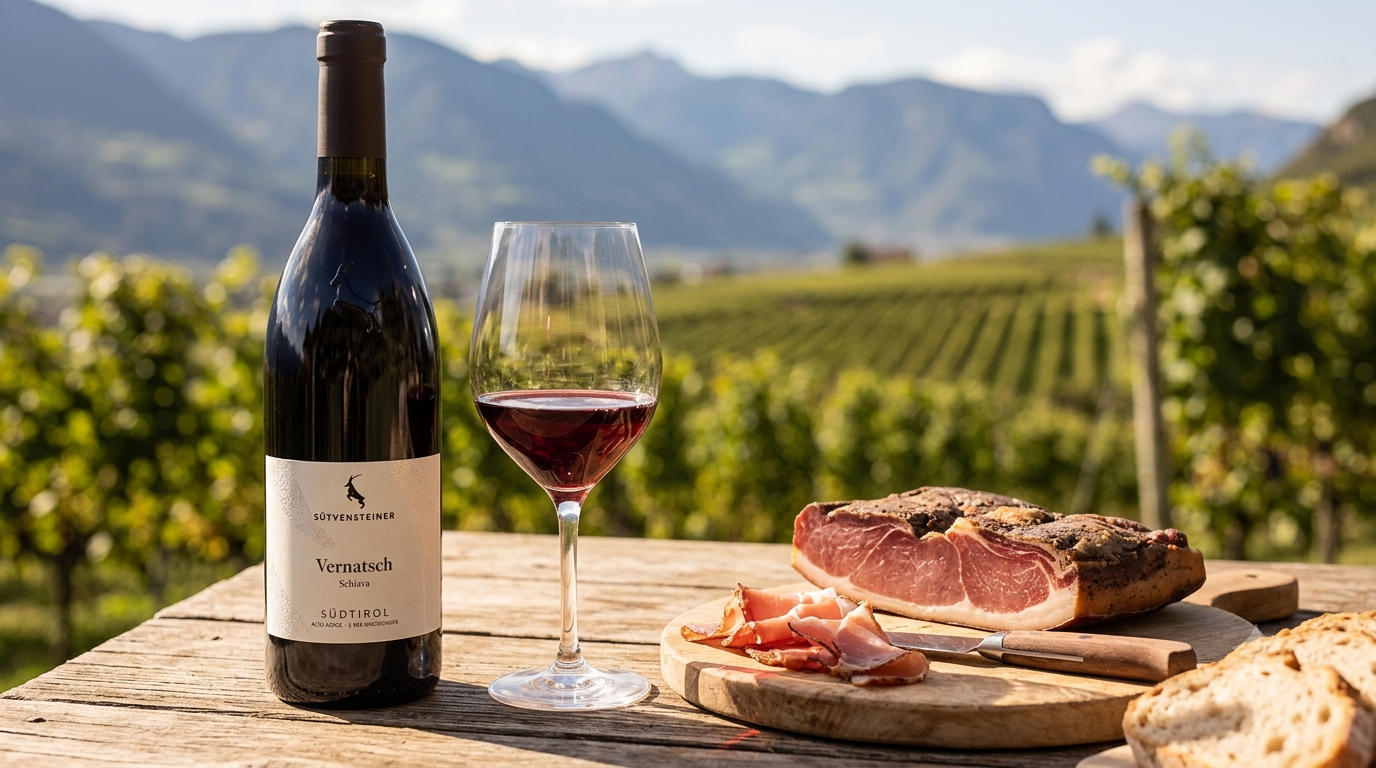
And yet the story of Vernatsch is not simply one of loss. Precisely because it no longer has to serve the mass market, it has gained in quality. Those who still grow Vernatsch mostly do so deliberately, often on old, ungrafted vines. That very fact is what makes it interesting again, especially for a younger audience.
That recognition can now be read in the awards, too: in 1990, the coveted “Tre Bicchieri” award from the Italian wine guide Gambero Rosso went to a Vernatsch for the first time – the Gschleier from Kellerei Girlan. In 2003 came the St. Magdalener from Bolzano’s Pfannenstielhof, and in 2012, for the very first time, a Lake Caldaro wine: the Puntay from Kellerei Erste+Neue. Alongside these accolades, targeted promotional initiatives emerged: the Südtiroler Vernatsch Cup, launched in 2004; the “Dolomiten” Vernatsch competition, running since 2014; and the “Charta Kalterersee” quality initiative from the Kalterer Weintage — all aimed at repositioning Vernatsch as a versatile, distinctive and typically South Tyrolean wine.
As a representative of the internationally sought-after “light-bodied red wines” – light, fruity, with moderate tannins and floral violet notes – Vernatsch is increasingly finding favour among young sommeliers; served chilled, it makes an aperitif wine that is hard to beat. The Südtiroler Vernatsch Cup, held annually, confirms this trend and puts young winemakers and their interpretations of the variety in the spotlight.
From the everyday wine of the post-war years to a deliberate rediscovery: Vernatsch has come a long way, and it seems the most exciting part of that journey still lies ahead.
Sources:
- Vernatsch – Wikipedia
- Vernatsch · Suedtirolwein
- Südtiroler Vernatsch Cup 2025 · Suedtirolwein
- Herbert Taschler: Südtiroler Vernatsch – gestern, heute, morgen, Athesia-Tappeiner Verlag, 2018
- Photos: Gemini AI