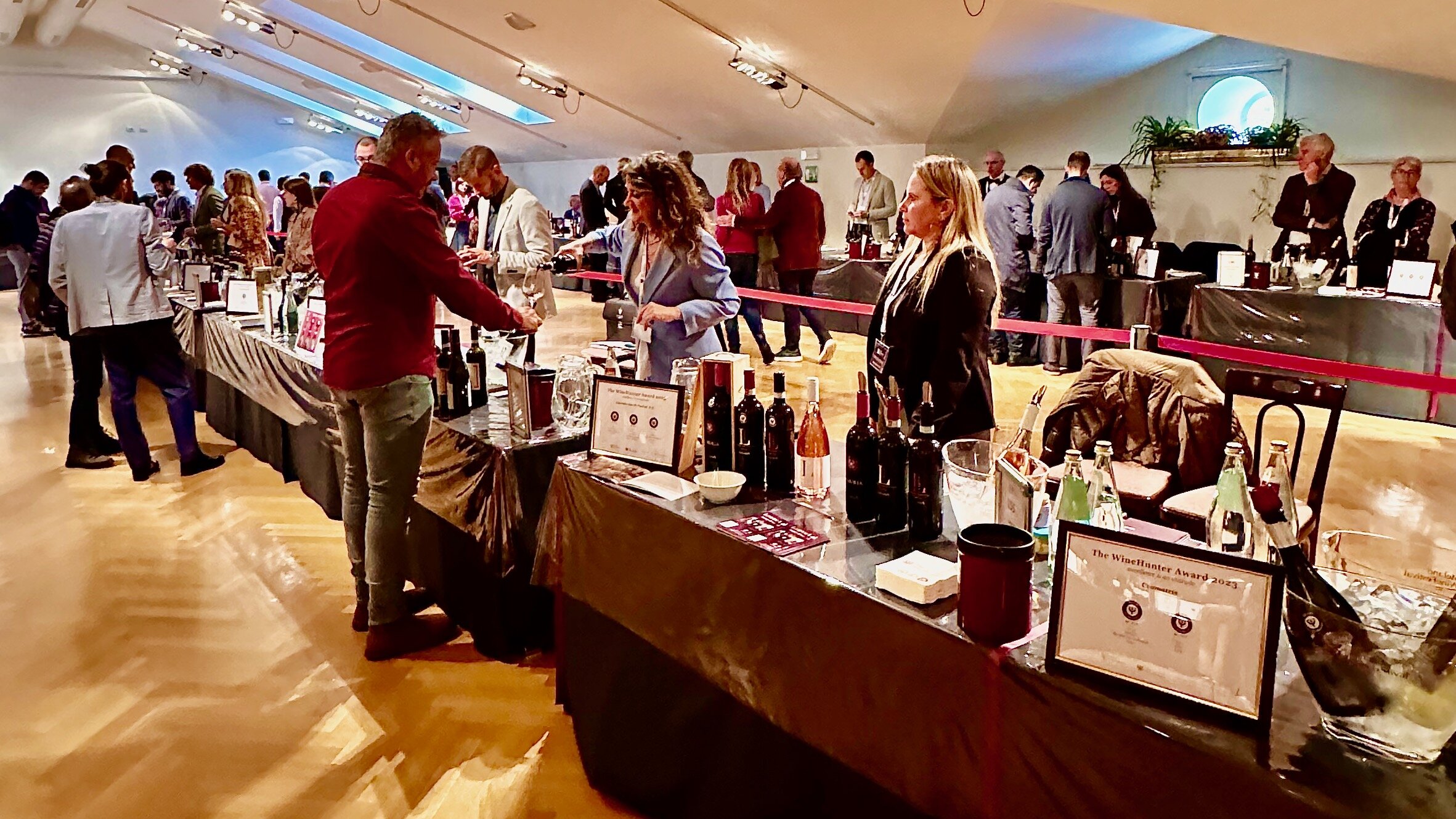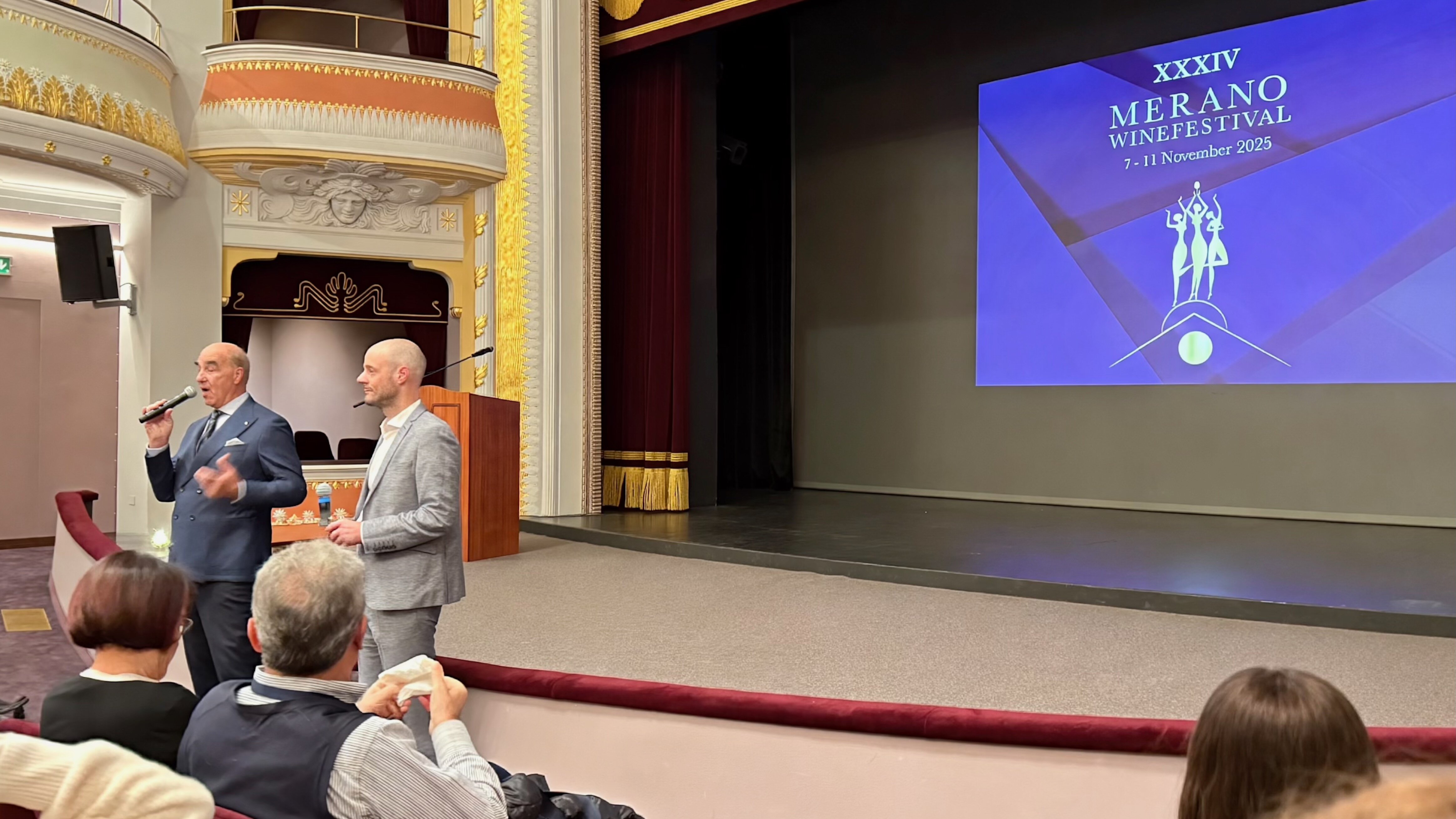
What place does research have at the Merano WineFestival? More than you might think. Even before the first glass is raised on Friday to mark the opening of the anniversary edition, the "Puccini" City Theatre will belong to science at 9:00 AM: The summit "Breath and cry of the earth" enters its next round. It was created to discuss the consequences of climate change on viticulture and potential solutions. Once again, the International Viticulture & Enology Society (IVES) is joining as a partner this year.
FLASHBACK: MERANO WINEFESTIVAL 2025
The summit kicked off with two high-profile personalities: Helmuth Köcher, founder and mastermind of the event, and Julien Dumercq, director of IVES – International Viticulture and Enology Society, who moderated the expert panels curated by the international society.
Köcher is a familiar face to anyone who follows the WineFestival. The WineHunter, who has been scouring the globe for food and wine excellence for over thirty years, succeeds year after year in surprising both the public and industry experts with a format that bridges tasting, culture, and research. Dumercq, on the other hand, brought the perspective of someone coordinating the international viticulture research community—the perfect counterweight to the festival's more sensory and emotional side.
On one side, the intuition of the explorer. On the other, the precision of science. But what was it that actually held the two together?
THE VINE ON TRIAL
The answer was provided by the following two presentations given by two researchers who spend their days at CIRVE and C3A—the viticulture and enology research centers at the Universities of Padua and Trento—asking the vine questions that the general public rarely considers.
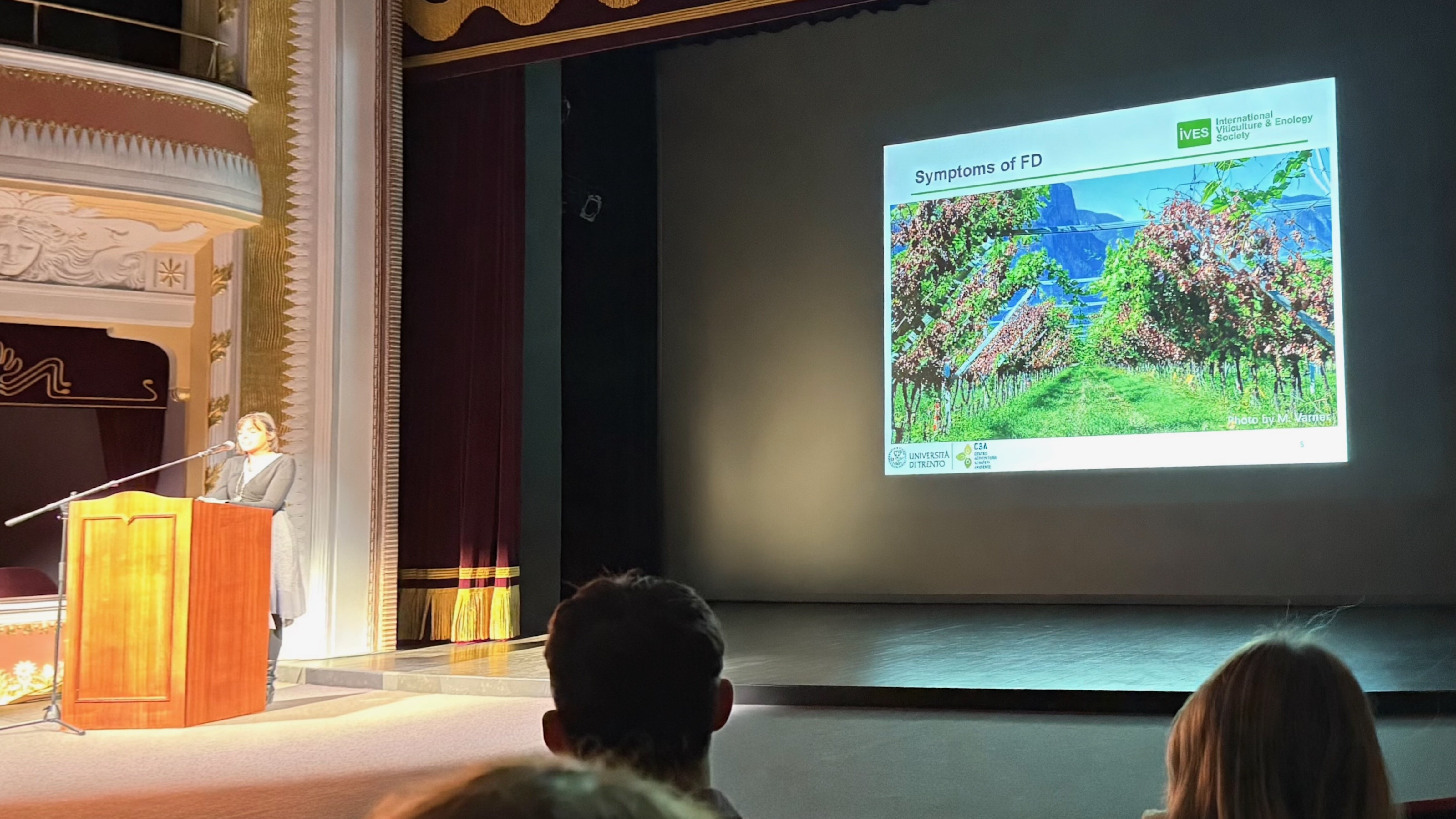
Monica Canton kicked off the session with an insight into plant physiology: how does the vine manage—or struggle to manage—its own carbon reserves in an increasingly unpredictable climate? Rachele Nieri, coming from a completely different scientific angle, led us into a domain that almost resembled espionage: vibrations, intercepted love duets, hacked communication. She addressed the question of how to curb the spread of Flavescence dorée without spraying a single gram of insecticide.
Two entirely different levels of observation: the molecular level of the plant and the behavioral level of the insect. One big question in common: how do you practice viticulture when the rules of the game are changing under your feet? Or, to be more precise: under your roots?
THE VINE THAT TELLS THE STORY OF CARBON
A plant that must decide every single day how to spend its savings. This is not a poetic image, but precisely what the vine does when managing its energy budget—and climate change is making its life increasingly difficult. At the Merano WineFestival Summit, Monica Canton from CIRVE (Interdepartmental Centre for Research in Viticulture and Enology at the University of Padua) brought this question straight to the heart of plant physiology.
THE UNSEEN SUGAR
Everyone remembers photosynthesis from school days. Less known is the second life of that sugar once it is produced. Part of it becomes structure: wood, shoots, leaves. Another part is set aside, like savings under the mattress: the non-structural carbohydrates, starch and soluble sugars, which are stored primarily in the wood and roots. It sounds like a technical laboratory detail. But it isn't. Because it is precisely this reserve that allows the vine to restart every spring, even before the leaves are functional enough to work. It is the plant's savings account. And like any savings account, it comes under pressure in times of crisis.
WHEN THE CLIMATE SHUFFLES THE DECK Rising temperatures, increasingly dry summers, an atmosphere with ever more CO2: three variables, a single target—the vine's carbon balance. The heat causes phenological phases to start earlier and accelerates metabolism. Water stress forces the plant to close its stomata to prevent moisture loss—a defense mechanism that effectively suffocates it and throttles photosynthesis just when it is needed most. And the excess CO2? A double-edged sword whose effect depends heavily on how it interacts with heat and drought. The result? A plant that, in the toughest vintages, must choose between survival in the here and now and providing for tomorrow. It almost always chooses the former. And enters winter with lighter pockets than usual.
WHY THIS ISN'T JUST A PROBLEM FOR BOTANISTS
Low reserves in autumn mean weaker budburst the following spring. They mean plants that are less prepared to react to a late frost or a sudden pest infestation. Ultimately,they mean fewer grapes and lower quality—words that carry more weight in the cellar than any chemical formula.Understanding these mechanisms is not an academic exercise: it is the foundation for tomorrow's decisions, from canopy management to selecting clones that are more efficient at managing their own reserves. Ultimately, the vine doesn't need to speak to be understood. You just have to look at what it does with its carbon.
By Yerpo - Own work, CC BY-SA 3.0, https://commons.wikimedia.org/w/index.php?curid=28190584
THE VIBRATIONS OF YOUR ENEMY
Imagine a vine leaf as a clandestine telephone line. Along this line, two small insects exchange messages that no human ear can hear—unless you have the right tool at hand. Rachele Nieri, a researcher at the Center Agriculture Food Environment (C3A) of the University of Trento, has that tool, and at the Merano WineFestival Summit, she demonstrated how to intercept, or rather "hack," this conversation to curb one of the most feared diseases in European viticulture.
AN ENEMY THAT FITS IN A THIMBLE
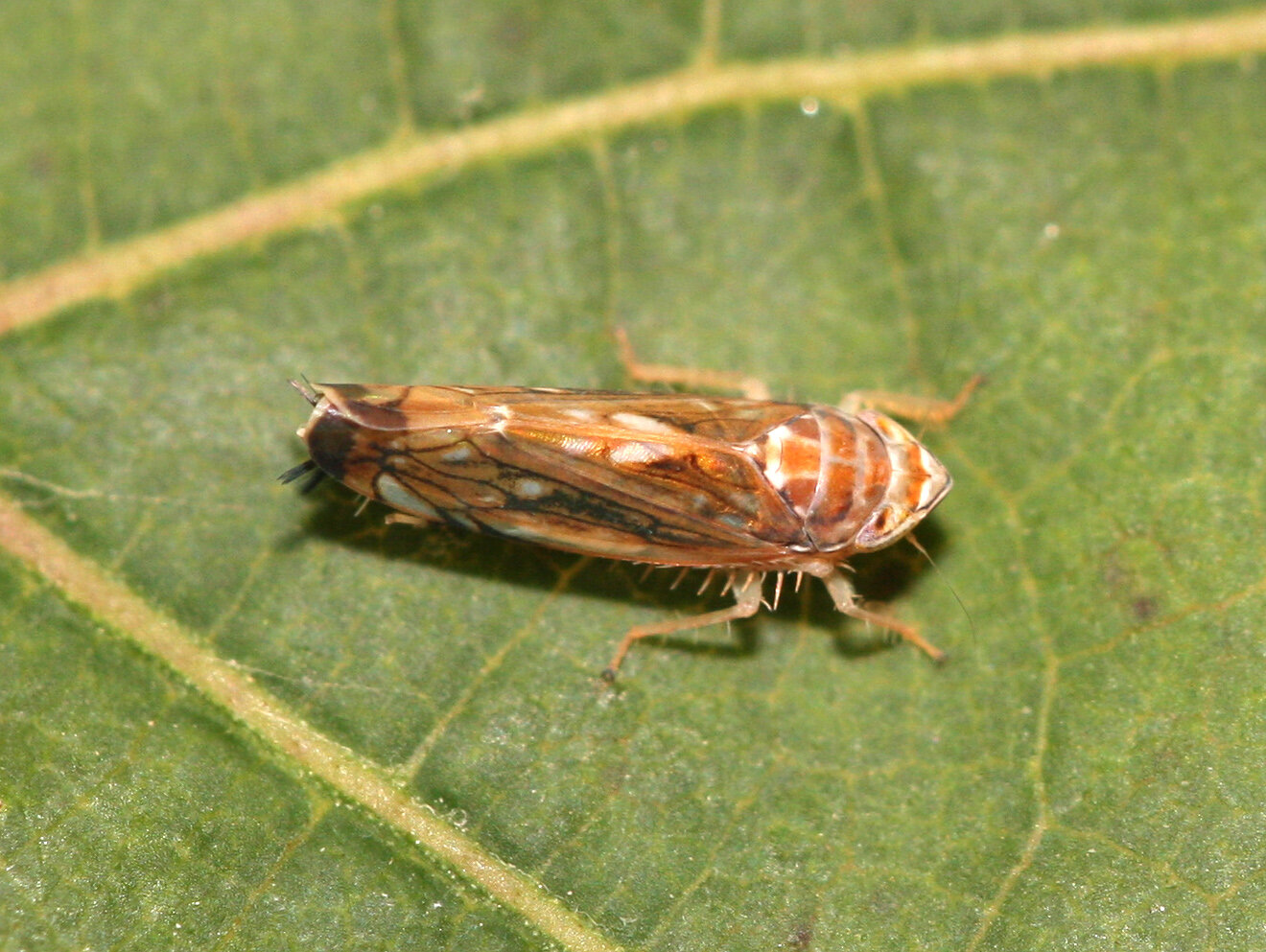
Scaphoideus titanus isn't intimidating to look at: barely half a centimeter long, native to North America, and brought to Europe almost by accident. But appearances can be deceiving. While feeding on the vine's sap, this leafhopper unwittingly transmits a phytoplasma responsible for Flavescence dorée, a disease for which there is still no cure today. The only weapon remains uprooting infected plants. Or, alternatively,stopping the insect before it causes damage.
THE SECRET LANGUAGE OF INSECTS
It is called biotremology, and it is the science that studies how animals communicate through vibrations. Not sounds in the air, but signals that travel through leaves, shoots, and wood. It is a research field that sat on the margins for decades. Yet over 200,000 animal species know no other language. In Scaphoideus titanus, courtship behavior revolves entirely around this: the male vibrates, the female responds, and between the two a duet forms that leads to mating. No physical contact. Just sap, wood, and frequencies.
NTERRUPTING THE DUET, STOPPING THE EPIDEMIC
What if you could disrupt this exact conversation before it reaches a successful conclusion? That is the idea—simple on paper, but anything but trivial in implementation—at the heart of the research Nieri contributed to. In nature, this already happens on its own: when multiple males compete on the same plant, those excluded from the duet emit jamming signals that mimic rivalry signals, interrupting the pair's conversation. This inspired the idea to artificially replicate the phenomenon: electronic devices known as "shakers," attached to vineyard posts at intervals of 30 to 50 meters, emit synthetic vibrations that confuse the insects' courtship. The duets break off. Matings decrease. And with them, the spread of the disease.
DEFENSE WITHOUT CHEMICALS
No insecticides, no chemical substances between the vines: only signals precisely tuned to the enemy's wavelength. To be sure, the technique requires precision: uniform coverage of the canopy,calibrated signal strength, and well-positioned transmitters. But the underlying principle remains almost disarmingly simple. Once, vibrational communication in insects was merely a curiosity for entomologists. Today, it is one of the most promising strategies for tomorrow's sustainable viticulture. And if there is one lesson to take away, it is this: sometimes the best defense isn't attacking the enemy, but simply learning their language.
THE 2026 SUMMIT
At the center of attention are five research studies in viticulture and enology: by Francesco Mirone and Sara Zanella from the CIRVE Viticulture and Enology Research Center at the University of Padua, Valeria De Rosa from the C3A Center at the University of Trento, and Matteo Migliorini from the University of Verona; the conclusions will be drawn by Emanuele Boselli from the Free University of Bozen-Bolzano. The topics focus on the effects of climate change, the vine's response to environmental stress, and the use of new technologies—issues that no winery can afford to put on the back burner any longer.
Practice follows close behind. On the same day, TasteTerroir – bio&dynamica demonstrates where the journey in the vineyard and cellar can lead: organic, biodynamic, and natural wines, wines from fungus-resistant (PIWI) grape varieties,amphora vinification, and even underwater aging.
Sources:
meranowinefestival.com
winenews.it
cirve.unipod.it
georgofili.it
en.wikipedia.org
© all rights reserved